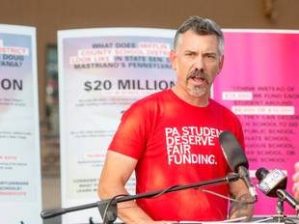
Today, a small group of citizens delivered a letter to Penn State’s administration, asking them to put together a plan to get to zero carbon emissions by 2050 at the latest. The letter, initially signed by 48 faculty, staff, and one student became a petition signed by over 7,100 people including the initial signatories. For background, you can read about it at Onward State and The Centre Daily Times.
Below, I’ve pasted my personal email/letter (pardon the errors) that I sent them the administration this morning before going to the letter-delivery event and the Getting to Zero letter itself with its signatories included.
I want to personally thank the people who attended. They include State College residents Jackie Bonomo and Pam Steckler (PSU class of 1969), undergraduate student Kyle (whose last name I don’t know), Cricket Eccleston Hunter (PA-Interfaith Power and Light), Joe Cusumano (Prof. Engineering Science and Mechanics), Jim Eisenstein (Prof Emeritus of Political Science and food activist), Ben Wideman (3rd Way Collective, Mennonite minister), and Julia Spicher Kasdorf (Prof English and Women Studies, poet extraordinaire). Jonathan Brockopp, who co-authored the original letter with me is in Tunisia this week, but he was there in spirit. And I know that others wanted to be with us too and were not. Thanks for the good will and support. (See pictures at the Facebook page.)
And, thank you Senior Vice President for Finance and Business David Gray. It was heartening to be heard and met and hear the administration’s firm commitment to sustainability as foundational to Penn State’s ongoing strategic vision. It gives us hope that we will be working toward a strong climate commitment. It’s another step on the long road and bumpy road we lay and tread. We will be here to support you to take the next steps.
We are…Penn State.
—
Dear President Barron, Provost Jones, and Vice President Gray,
I hope today finds you well.
Today, we deliver you a letter, signed by over 40 faculty and staff from across the disciplines and Commonwealth asking you to lead us forward on climate change. Since Dr. Jonathan Brockopp and I crafted and submitted the letter during the PSU Strategic Planning comments, we have placed the letter online as a petition. It has garnered over 7,000 additional signatures from dozens of countries from Sri Lank to Sweden. Hundreds of them are from Pennsylvania, numerous alumni/ae, and additional Penn State staff and faculty. We have attached the Pennsylvania signatories to this email because they are the citizens our land grant university most directly serves. We have also attached the original letter as well.
I would like to take the opportunity to add a few things, some of which Jonathan and I have said in previous emails to Provost Jones. First, we see this as an effort at supporting the work that we know is already happening across our university in research, teaching, outreach, and operations. Second, we see this as a moral issue on which informed people of conscience must come together to act, always imperfectly, to do what they can when and where they can. We deliver this letter to you today for special reasons.
December 2, 2015. We are in the last month of the hottest year recorded by humans on planet earth. We are nearing the end of the 30th year in a row during which every month has been above the average 20th century average. We are in the final month of a year with record-breaking tropical cyclones, unprecedented ice melts, Alaskan and Indonesian wildfires that combine to release more carbon into the atmosphere than the United States economy.
And we are also in the last month of the year during which people have taken actions big and small to act on climate. The list of climate actions is too long to list here, but a few ought to be recognized: the Clean Power Plan, the Papal encyclical Laudato Si, the rejection of the Keystone XL pipeline, blocking of coal rail in Wyoming and other fossil fuel infrastructure across North America, the continued descent in the price of solar energy, the progress of the divestment movement, MIT’s Plan for Action on Climate Change, and our own recent announcement about being the Energy University. Today is also the third day of the COP 21 talks in Paris where we hope world leaders taking steps to prevent serious climate disruption and create a brighter path for humanity. Let’s be with them in spirit.
Most of all, today is a day that we, the signatories, come to with a spirit of support and optimism to you: our leaders. On December 23, 1776, Thomas Paine wrote, “These are the times that try men’s souls. The summer soldier and the sunshine patriot will, in this crisis, shrink from the service of their country; but he that stands by it now, deserves the love and thanks of man and woman.” Let us not be the summer soldiers and sunshine patriots. We are those who stand now and who will be owed the love and thanks of our fellow men and women, by our ancestors who gifted us life, by our fellows who share the world with us today, and by our children and grandchildren.
—
Getting to Zero Letter
Dear President Barron, Provost Jones, and Senior Vice President for Finance and Business Gray:
We the undersigned recognize that human beings are disrupting the climate. As members of the most affluent and educated communities in history and among the most responsible for climate change, we recognize that we are called to protect the weakest among us, our descendants, and the biotic community. As a research university serving the commonwealth through its land grant mission, we are called to lead by example, demonstrating to our students, alumni, and the broader community how we can immediately and forcefully respond to this challenge.
Today, we renew a call sent to you by the 2014 Penn State “Getting to Zero” conference attendees. We urge the administration to do the following:
- President Barron should immediately create a task force to lead the community though the process of setting and implementing an appropriate “Getting to Zero” plan to be achieved by 2050 at the latest.
- Penn State’s administration should communicate its commitment to addressing anthropogenic climate change publicly, ideally through Penn State’s next Strategic Plan.
- Penn State’s administration should identify and revise policies that currently limit efforts to reduce greenhouse gas emissions through its operations, purchasing, and investments and should integrate sustainability throughout its curriculum and culture.
Accelerating climate-related impacts make the urgency of this call very clear. We know that you understand the overwhelming evidence for anthropogenic climate change. Now is the time to stand together, recognize our moral responsibility, and use every tool among our vast resources to address the consequences. The possibilities for our entire community—students, staff, faculty, and the communities of our Commonwealth, nation and the world—are limited only by our hearts and imaginations.
We ask you to make the tough choices required of leadership, and we are ready to support you in implementing those decisions.
Respectfully,
Jonathan Abel
Associate Professor of Comparative Literature and Japanese
Gabeba Baderoon
Associate Professor of Women’s, Gender and Sexuality Studies and African Studies
Mark Ballora
Associate Professor of Music Technology
Paul Barsom
Associate Professor of Music
Susannah Heyer Barsom
Sustainability Institute
Michael Bérubé
Director
Institute for the Arts and Humanities
James Gordon Brasseur
Emeritus and Adjunct Professor of Mechanical Engineering
Jonathan Brockopp
Associate Professor of History and Religious Studies
Elaine J Brzycki
Manager, Project Development
WPSU Penn State
Peter Buckland
Sustainability Institute
Darlene Clark
Senior Lecturer in Nursing
Women’s Leadership Initiative Faculty Mentor
Jamison E. Colburn
Professor of Law & Joseph H. Goldstein Faculty Scholar
Stephen R. Couch
Professor of Sociology
Joseph Cusumano
Professor of Engineering Science & Mechanics
Kenneth J. Davis
Professor of Meteorology
Scott DiLoreto
Greenhouse Manager, College of Agricultural Sciences
Rosa A Eberly
Associate Professor of Communication Arts and Sciences and English
James Eisenstein
Professor Emeritus of Political Science & Public Policy
Leland Glenna
Associate Professor of Rural Sociology
Larry Gorenflo
Professor of Landscape Architecture
Neill Johnson
Director, Penn State Learning
David W. Jones
Environmental Engineering Lab Manager
Julia Spicier Kasdorf
Professor of English and Women’s Studies
Mark T. Kissling
Assistant Professor of Education
Andrew Lau
Associate Proferssor of Engineering
Li Li
Associate Professor of Energy and Mineral Engineering
Michael E. Mann
Distinguished Professor
Director
Earth System Science Center (ESSC)
Ian Marshall
Professor of English and Environmental Studies
Raymond Najjar
Professor of Oceanography
Sylvia Neely
Associate Professor Emerita of History
Caitlin Osborne
Instructor of Dance and Theatre Arts
Kyle Peck
Professor of Education
David Post
Professor of Education
Madhu Prakash
Professor of Education
Jamie Quail
Undergraduate Student of Psychology and Environmental Inquiry
Brandi J. Robinson
Lecturer
Energy and Mineral Engineering
John Roe
Professor of Mathematics
Steven Rubin
Associate Professor of Art
Sajay Samuel
Clinical Professor of Accounting
Elizabeth Smolcic
Assistant Professor of Education
Susan Squier
Brill Professor of Women’s, Gender and Sexuality Studies and English
Dana L. Stuchul
Associate professor, Department of Curriculum & Instruction
Janet K. Swim
Professor of Psychology
Chris Uhl
Professor of Biology
Jennifer A. Wagner-Lawlor
Associate Professor of Women’s, Gender, and Sexuality Studies and English
Catherine Wanner
Professor of History and Religious Studies
Denice H. Wardrop
Senior Scientist
Director, Penn State’s Sustainability Institute
Ben Wideman
Campus Pastor for 3rd Way Collective
 Peter Walks for Democracy
One thought on “Penn State Getting to Zero Climate Letter”