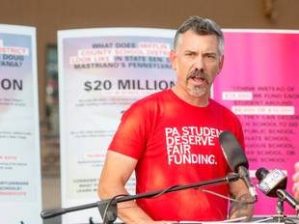
Last night the State College Area School District board voted to go ahead with the rooftop solar projects on the elementary school renovations with a 5-4 vote. That’s the leadership our community is looking for. Below are the full comments I’d prepared for the meeting.
My name is Peter Buckland. I am a resident of Ferguson Township and the father of a 10-year-old boy who attends the Delta Program. I’m also on the Ferguson Township board of supervisors. Though I will speak briefly about recent board decisions, I am not speaking on behalf of the board nor the township government.
First, I want to thank the school board for your work, congratulate those who won re-election last night, and those who will soon join you. You do our citizens and our children well.
I want to address the board regarding the three elementary school renovation projects, in particular the decision to include or “value engineer” out rooftop solar photovoltaic power. It has come to my attention that the board has received some estimates on cost and return on investment. I won’t belabor what those projections are, but I would like to address some things about those estimates that should trouble us all and how value engineering these things out will also engineer out the values we hold most dear.
There are some things to consider that aren’t in these calculations. Immediately, the assumptions in the return on investment estimate assumes an obscenely low cost for electricity. In our part of the commonwealth, our grid cost is artificially low. These low prices will not hold.
Additionally, there is no incorporation of any price being put on carbon dioxide or other greenhouse gases. If a carbon tax comes along, the cost on the grid is going to change. Were the district to shadow price carbon at $27 a ton of CO2—which was the estimated social cost of CO2 per ton by the EPA until the current administration—you’d find the payback on the arrays to be quite different. I haven’t done a precise calculation for the amount of carbon your PV would avoid. But if the cost were to stay at $27/ton, you would avoid between $1200 and $1800 in costs per array per year. Every economist and smart policy maker worth his or her salt from Henry Paulson to George Schultz to Mike Bloomberg to Christy Todd Whitman says that we should price carbon. This pricing will happen and it will change our energy economy and shift it toward renewable energy.
But more to the point, I think that the school board needs to ask itself a question about our values. Martin Luther King, Jr. said (and pardon the lack of recognizing women), “The ultimate measure of a man is not where he stands in moments of comfort and convenience, but where he stands at times of challenge and controversy.” At this moment I’d ask whether you want to be leaders when it’s clear that leadership is needed or if we are going to shirk the responsibility, kick the can down the road, and to acquiesce to an energy system that’s unequivocally driving a global climate calamity. The time of climate change is a time of controversy. But it’s the wrong kind.
Every single scientific, military, actuarial, and investment body worth anything has stated that climate change is a pressing problem caused by our energy system. The IPCC, the National Climate Assessment, the PA Climate Impacts Assessment, and every climate scientist at our own Penn State University says this and the evidence is ubiquitous. The US military calls it a threat multiplier that creates cascading risks, including some in the United States such as at Norfolk Naval Base or the “bathtub” of the Gulf of Mexico or the burning forests of the American west. Insurance giants like Munich RE and Swiss RE are calling on us to change and prepare because the cost of insuring coastal property, farms, and fisheries is rising. The World Economic Forum has placed the threat of not dealing with climate change on par with the threat of nuclear weapons and terrorism and above pandemics. They are all also saying that the opportunity through conversion to a renewable energy and wise land use economy is necessary, feasible, and will do us well by doing good.
Does SCASD want to drive innovation or stagnation? Does SCASD want to model community job creation or the outsourcing of skills to somewhere else? Does SCASD want to continue a status quo that feeds the most corrupt political and economic class in our country or does it want to empower community decision making? These decisions instruct our community by embodying values.
Of utmost importance to this body is whether our community wants to see this. Yes it does. Today, there are fifteen city and municipal governments that have signed on to the We Are Still In campaign that have pledged to take action aligned with the goals of the Paris Agreement. Additionally, about a dozen colleges and universities and dozens more businesses and leaders have signed. Ferguson Township and Penn State are among them. The small but significant step to bring solar to the area will be an act of leadership and one of solidarity. And our community wants it. Author Russel Gold an energy reporter for the Wall Street Journal told me that there’s never been a love for something in energy like there is for solar. National public surveys place it as the most liked form of energy. People here want you to lead on this.
For my part, the values embedded in solar on schools are values of sense, of sustainability, of community, and of local and global citizenship. Perhaps they cost more in dollars than we would like, but the cost in unrealized imagination is much greater. Ultimately, I think this is a question of values and not of dollar value, especially when the dollar estimates are warped.
If we believe that hard decisions make us better people and a better community, then we have to be willing to make those hard decisions so that we become better together.
Thank you.
 Peter Walks for Democracy
One thought on “Solar schools in the State College Area School District”