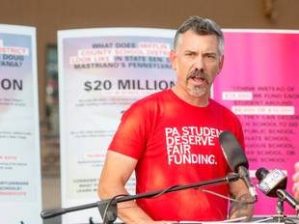
Today, I’ll be giving a Lightning Talk with Dr. Paul Shrivastava* at Penn State’s Energy Days. Our talk is on Energy Transition. My remarks are below.
My name’s Peter Buckland and I’m the chair of the Ferguson Township board of supervisors. Ferguson Township is just a couple of miles to our west here, population of about 19,000 on 50 square miles of farms, forests, light industrial and research, and suburbia and a budget of about $19 million. We are a two-year Tree City awardee, ranked third best place to live in Pennsylvania by Niche in 2017, and are a Gold Certified Sustainable Community under the STAR community index. Enough bragging. In Ferguson Township, we want to not only sustain that high quality of life, but to extend it beyond our boarders. That’s why we are acting on climate change. To do that, we must act on the moral duty to do energy so much better as former South Carolina Republican representative Bob Inglis has said.
A year ago when it became clear that the federal government was going to abdicate its responsibility and withdraw from the Paris Agreement, I put forward Ferguson Township’s resolution to act on climate change. One month later, we adopted Resolution 2017-14 (read the text here). In that resolution, we recognized three big things. First, human-caused climate change is a threat to current and future generations of Pennsylvanians and a global drawdown needs to start as soon as possible. Second, our Commonwealth constitution’s Article 1, Section 27 guarantees our right to “clean air, pure water, and the preservation of natural, scenic, historic, and esthetic values of the environment” and our own Community and Environmental Bill of Rights says the citizens of our township have a right to a “clean energy future.” Third, and finally, the technology, practices, and will to act on an energy transition are right here with us today.
Our resolution requires that we immediately begin to plan to draw down emissions to net zero by no later than 2050, that our plan be fair, transparent, and economically feasible, and that we engage our peers across all sectors. The only things stopping us are inertia, fear, a lack of imagination, and, as Penn State’s Evan Pugh Professor of Geosciences Richard Alley has said, a handful of people who’ve managed to break the conversation. We’ve said enough is enough. It’s time to act.
And acting we are. Our 6-member Climate Action Committee—led by Dr. Brandi Robinson who is right back there—are assembling an inventory of our township’s emissions so that we know how to respond. Along with our Council of Governments Sustainability Planner, Ferguson Township is one of twenty municipal and city governments who are learning the ins and outs of climate assessment with ICLEI, Local Governments for Sustainability. We value data, analysis, science, our land, and the trust of our residents for our decision-making. So we’re taking our time so that we know what to do, where, and with whom.
In the meantime, though, we and other local public entities in the region are taking action. We have a public works building in design that will be powered by solar PV. As of 2017, Ferguson Township and our Council of Governments are buying all of our electricity through wind renewable energy credits. Since early 2018, about 35% of our regional sewer authority’s power comes from a 9-acre 2.7 MW solar array. Three local elementary schools and our high school have or are about to install rooftop PV. Our fleets are moving bit by bit in the right direction. But we know that utility-scale solar is on the rise and some members of our board and other regional governments are starting to think about pooling resources to enter into a long-term Power Purchase Agreement for solar or wind. That’s very early stages but the ideas and interest are there. Nevertheless, I have no doubt that the renewable energy future is sprouting right here in PA and that it will fundamentally change our mix and will take Pennsylvania from 1% of the world’s emissions to net zero in just a few decades.
Our changes here may seem infinitesimal. But a pilgrimage doesn’t happen with a matter transporter. It happens when each pilgrim takes one step at a time. Altogether, their steps can take them hundreds, even thousands of miles. We are taking those steps and others are joining us. Together, we are going to change Pennsylvania’s energy future.
Thank you.
*Paul Shrivastava is my boss at Penn State’s Sustainability Institute.
 Peter Walks for Democracy