Some members of our community are wondering if the State College Area School District will be accessing funding from Pennsylvania’s Solar for Schools program. The answer is, “YES!” As I posted yesterday in “Make action on climate change part of everyday life,” we have a lot going on in the District to support climate action. Integrating solar into our plans and designs is part of that.
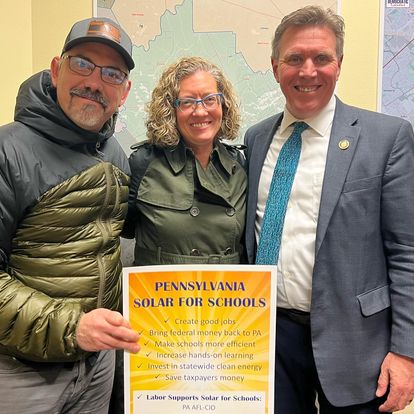
As soon as Rep. Elizabeth Fiedler announced plans to advance Solar for Schools, my fellow SCASD Board member and School Leadership in Clean Energy partner Gretchen Brandt and I approached Rep. Paul Takac* (D, HD-82). He subsequently co-sponsored the bill. It’s not surprising considering he’s the Secretary of the House Climate Caucus, an early supporter of our solar power purchase agreement, and a huge supporter of public education.
Solar for Schools (S4S) provides districts with funding for “solar energy projects” (more on that below). Because it is a state program, it can be stacked with the elective/direct pay from the Inflation Reduction Act to offset 80-100% of solar installation costs. S4S is a quadruple win: secure energy and energy bills, climate action, Pennsylvania jobs, and response to voter demands.
SCASD will access S4S for our next projects: Mt. Nittany Elementary’s expansion and the new Park Forest Middle School design which is part of our District Wide Facilities Master Plan. While we don’t know the total costs yet, knowing we will only pay 20% is a huge incentive. It undeniably helps to make solar “mainstream and no longer viewed as ‘something revolutionary or confrontational.'”
Recently, Ferguson Township supervisor and fellow solar champion Omari Patterson asked me if SCASD could use S4S to support our intergovernmental solar power purchase agreement (SPPA). That project aggregates power from 10 (could be 11 again) local governments and will place it into an affordable, carbon-free, Pennsylvania solar project. Its projected rate will save our local governments $4 million and avoid 240,000 tons of carbon dioxide over the contract’s 15 years. [Access documents related to the SPPA.]
I’m going to go back in time. In the early phases of exploring the PPA, we decided against 1. owning a single solar farm, 2. leasing property to a developer, or 3. building a set of distributed solar facilities. Aggregation among the entities creates the economy of scale that helps us achieve the low rate. Based on my experience on the Penn State SPPA team, I saw that the cost/kWh leveled out with projects over 5 MW and definitely over 10 MW. We wanted a decently big project.
- Could we own it? No. State law prevents a local government from owning and operating a facility over 5 MW. Given that we had fifteen local governments in our initial group, who would own the project? A new authority?
- Were any of us willing to lease a large piece of land to a developer? Since we knew we were looking at something bigger than 10 MW (we had over 30,000,000 kWh in total in the group, about 25 MW of installed capacity) we needed at least 60 acres of land on the small size and 150 on the large size. The only member of the working group that might have that much open space was the State College Borough Water Authority. They were not interested in leasing.
- Could we meet demand by building solar facilities across the many roofs, lawns, and parking lots of the (initially) fifteen entities? First, that would not be aggregation. It would therefore lose cost benefit of the economy of scale. Kind of self defeating. Since we started this before the Inflation Reduction Act’s and Infrastructure Investment and Jobs Act’s passage, the direct/elective pay and reimbursement possibility was not present. The Get Solar project from the PA Solar Center also didn’t exist. Even with those, it would be very very expensive. We’d lose the labor savings of aggregating staff time. Even if these were in place, the capital investments by each organization would be considerable.
We never considered the following. But I have been asked: Could the State College Area School District go it alone, use Solar for Schools and the IRA today and meet the 80% power goal we have in the SPPA? No. With our commitment of about 15,000,000 kWh of electricity going into the SPPA, we face all of the issues above: can’t own a >5 MW project, the capital expense to get near 12 MW on roofs, land, or parking lots would be extremely high, and it is vanishingly unlikely to produce the economy of scale we get in the SPPA.
But even still, as Patterson asked, can the SPPA use Solar for Schools even if it is built, owned, and operated by a developer? When asked, I doubted it. The legislation says on page 3 that it supports the construction of a “Solar energy project.” A project at a school facility related to photovoltaic or solar thermal devices that convert, transfer or store solar energy in or into usable forms of thermal or electric energy (italics mine).” Fortunately, I attended a program hosted by the Office of Critical Investments who confirmed that I am correct. Even still, the developer is able to access tax credits through the Inflation Reduction Act that play a positive role in keeping our SPPA rate low.
While we can’t use the S4S for the SPPA, we definitely will be using it for future projects. It’s good for energy costs and stability, for climate action, for jobs, and our kids.
* My wife managed Takac’s campaign in 2022 and is doing so again in 2024.
 Peter Walks for Democracy
I’ve never read a more thorough explanation of a project and its merits, Peter – Thanks for your years of hard and unceasing work to make this happen. Thanks also to Paul Takac for his role in this initiative. And thanks to your wife for helping him win his seat in the Pennsylvania House, this will be his second win on November 5th! “Do not be daunted by the enormity of the world’s grief. Do justice now. Love mercy now. Walk humbly now. You are not obligated to complete the work but neither are you free to abandon it.” The Talmud
LikeLike